Users see a much richer experience than many automated systems can confidently extract. This creates a gap between the customer-facing site and the search-facing version of the site.
A strong shopping experience needs stronger search foundations.
The Hale has a credible commerce experience and a clear customer promise. The main growth constraint is not visual design; it is the consistency, crawlability, and authority of the signals search engines and AI answer engines use to understand the site.
When important SEO signals depend on how and when a page is rendered, organic discovery becomes less predictable. The result is weaker indexing confidence, weaker category visibility, and less surface area for AI-driven search experiences.
Core SEO signals need to be more reliable for crawlers and AI systems.
The opportunity spans homepage, category, and product-page templates.
Speed is not the main blocker; the bigger issue is search-ready delivery.
The site has started the right direction but needs more citability.
What is holding organic growth back.
These are grouped at the opportunity level so leadership can evaluate impact before moving into implementation.
Indexation, metadata, URL consistency, and discovery signals should tell one clean story across public pages. Right now, those signals are not as unified as they should be.
Category pages should do more than display products. They need crawlable decision support that helps shoppers and search engines understand what each category is for.
Product pages have commercial value, but their SEO structure needs to better reinforce product relevance, proof, availability, and customer confidence.
Schema should support the business model without becoming noisy, inconsistent, or dependent on fragile rendering behavior. This needs a controlled template-level cleanup.
The mobile experience is usable, but some interface patterns create trust and usability friction. These are not the biggest SEO blockers, but they matter for conversion and engagement.
Hale has taken steps toward AI discoverability, but answer engines need clearer crawlable passages, stronger source signals, and more structured explanations of expertise.
Content and digital PR will work harder once the site foundation is stable. The right order is technical clarity first, authority expansion second.
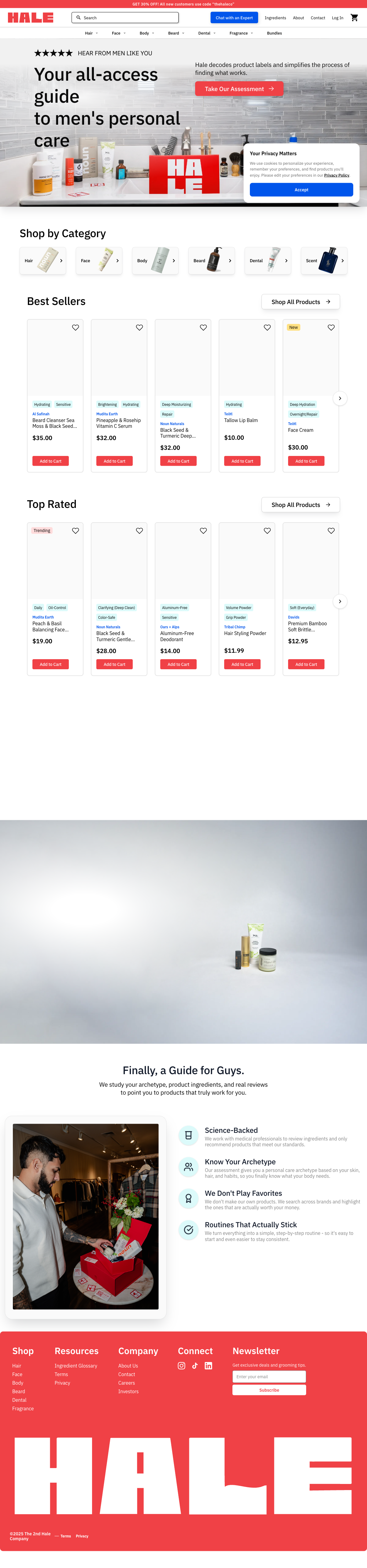
What customers see is not always what search systems value.
The customer experience is visually credible. The growth opportunity is making the same value easier for search engines, social scrapers, and AI assistants to understand consistently.
| Area | Current Risk | Business Impact | Why It Matters |
|---|---|---|---|
| Homepage | Brand story and recommendation logic need clearer search-facing structure. | Lower confidence for branded and non-branded discovery. | The homepage should explain what Hale is, who it serves, and why its recommendations are trustworthy. |
| Categories | Commercial pages need stronger intent-matched guidance. | Missed opportunity to rank for category and problem-aware searches. | Searchers often need help choosing, not just a grid of products. |
| Products | Product pages need cleaner machine-readable trust signals. | Weaker eligibility for rich discovery and lower confidence on purchase-intent pages. | Product SEO should support both search visibility and buyer confidence. |
The report identifies the strategic areas where Hale is losing organic leverage: crawl confidence, content depth, structured data quality, mobile trust, AI search readiness, and authority.
The detailed implementation plan should be handled in a guided phase, with template-level changes, validation, and measurement handled in the right order.
The site is fast enough to compete, but not clear enough to compound.
Performance is a strength. The bigger opportunity is making the existing experience easier for search systems to discover, classify, and trust.
Lab testing indicates the site is not primarily held back by load speed.
Public templates need to send clearer signals before expansion work begins.
Mobile and interface polish should be addressed alongside SEO cleanup.
The site has a credible commerce flow, modern visual presentation, product imagery, public crawl access, and a performance profile worth protecting.
The technical layer needs careful sequencing so indexation, metadata, structured data, internal linking, and measurement move together instead of creating more fragmentation.
Hale needs more crawlable proof of why its recommendations matter.
The brand promise is useful: simplify men's personal care. The site should make that promise easier to verify through clear methodology, category education, product context, and authority signals.
Clarify what Hale does, how recommendations are made, and why shoppers should trust the curation process.
Turn category pages into buyer guides that answer common questions and support product discovery.
Make product pages stronger sources of relevance, comparison, review context, and purchase confidence.
The next content phase should not be generic blogging. It should build topical authority around grooming decisions, routine-building, ingredients, product selection, and the reasons Hale is qualified to guide those decisions.
Schema should clarify the business, not create noise.
Structured data can help Hale qualify for richer search experiences, but only when it is consistent, current, and aligned with the actual page content.
Structured data should be managed at the template level so homepage, category, and product pages send consistent signals.
Markup should be reviewed for duplication, outdated patterns, and mismatches between what the page shows and what the schema claims.
Clean schema gives search engines more confidence in the entity, products, reviews, breadcrumbs, and commerce context. Messy schema does the opposite: it adds ambiguity exactly where clarity is needed.
Fix the foundation, then build demand.
The work should be sequenced so technical clarity comes before content expansion. That keeps future content and authority-building from leaking value.
Phase 1: Search foundation cleanup.
Stabilize the core technical signals search engines use to discover, classify, and trust public pages.
Phase 2: Template and structured-data refinement.
Strengthen homepage, category, and product-page templates so they communicate the right information consistently.
Phase 3: Content architecture and AI readiness.
Build crawlable explanations, buyer guidance, and answer-ready content around Hale's core categories and recommendation model.
Phase 4: Authority and measurement.
Layer in authority-building, internal reporting, and performance tracking once the SEO foundation is stable.
What users see.
The rendered site has the bones of a real shopping experience. The opportunity is making that experience easier for search systems to understand and reward.
How the opportunity was identified.
This brief is based on a detailed review of The Hale's public SEO surfaces. The next working phase should translate these findings into a validated implementation plan.
